双波长非剥脱点阵激光FraxelFTX
2026年9月4日10 min read
Journal of Cosmetic Dermatology
结论与实践要点
设备定位: 双波长非剥脱点阵是面部年轻化的『午休式』光电手段——1550nm 管深层(皱纹 / 瘢痕)、1927nm 管浅层(色素 / 肤质),可灵活组合。对我门诊,适合作为光电年轻化的主力,或与射频、注射联合作为维持手段。
体验数据的价值与边界: 冷却与手具升级直接改善舒适度(88% 疼痛极轻),利于患者依从;但『95% 满意』来自厂商 beta 测试调查,需独立数据交叉验证,不能当作疗效定论。引进设备时应以自身临床观察为准。
证据层级: 本文是通讯 / 问卷,非严格 RCT;疗效数字(I-GAIS 3.4)属『轻度-中度改善』,应如实传达,避免过度承诺『显著』或『逆转』。非剥脱点阵的优势本就在『低停工期、渐进式改善』,而非一次到位。
循证边界与合规: 作为设备真实世界体验报告,科普时应标注『样本小、白人为主、随访短』,不夸大其词;符合合规要求(去除绝对化表述)。对求美者沟通应强调『按皮肤类型与耐受分层、合理设定期望』。
To the Editor,
The next‐generation dual 1550‐nm erbium glass fiber and 1927‐nm thulium fiber non‐ablative fractional laser system (Fraxel FTX system; Solta Medical, Bothell, WA) was launched in 2025. Compared with the previous‐generation Fraxel DUAL system, enhancements include a lighter and more ergonomic handpiece, integrated tubing with directed cooling, a redesigned treatment tip, an enhanced user interface, and an updated optical tracking system. The system operates at the same wavelengths that, in a previous study, were associated with a quartile clinical improvement score of 1.9 (1 = 1%–25% improvement; 2 = 26%–50% improvement) for photodamage and pigmentation after ≤ 4 sessions [ 1 ]. The 1550‐nm laser coagulates the epidermis and dermis with ≤ 1.6‐mm depth of penetration, addressing severe sun damage, wrinkles, acne scars, and surgical scars. The 1927‐nm laser coagulates the epidermis and superficial dermis with ≤ 0.3‐mm depth of penetration, addressing mild‐to‐moderate sun damage, pigmented lesions, skin texture, and actinic keratosis [ 2 ].
A beta‐testing survey was conducted among 22 providers who treated 97 patients with the next‐generation device. Reflecting real‐world clinical practice, treatment protocols and posttreatment regimens were not standardized, enabling providers to customize treatments according to their own clinical experience and judgment, patient tolerability, skin condition, Fitzpatrick skin type, and body area. Providers assessed efficacy via Investigator Global Aesthetic Improvement Scale (I‐GAIS; 1 = worse; 5 = significant improvement) and quartile improvement scores (0 = no improvement; 4 = 76%–100% improvement), monitored safety, and answered questions about user experience. Patients completed surveys about comfort and satisfaction immediately after treatment ( n = 85), during the healing process (7–14 days after treatment; n = 65), and 3–8 weeks after treatment ( n = 38) and rated esthetic improvement via Patient Global Aesthetic Improvement Scale (P‐GAIS). Outcomes were analyzed on an as‐observed basis.
Patients were predominantly female (89%) and White (73%), with most having a Fitzpatrick skin type of II (53%). Common treatment objectives were dyschromia and fine lines and wrinkles. Patients were treated with the 1550‐nm laser (14%), 1927‐nm laser (40%), or both (45%).
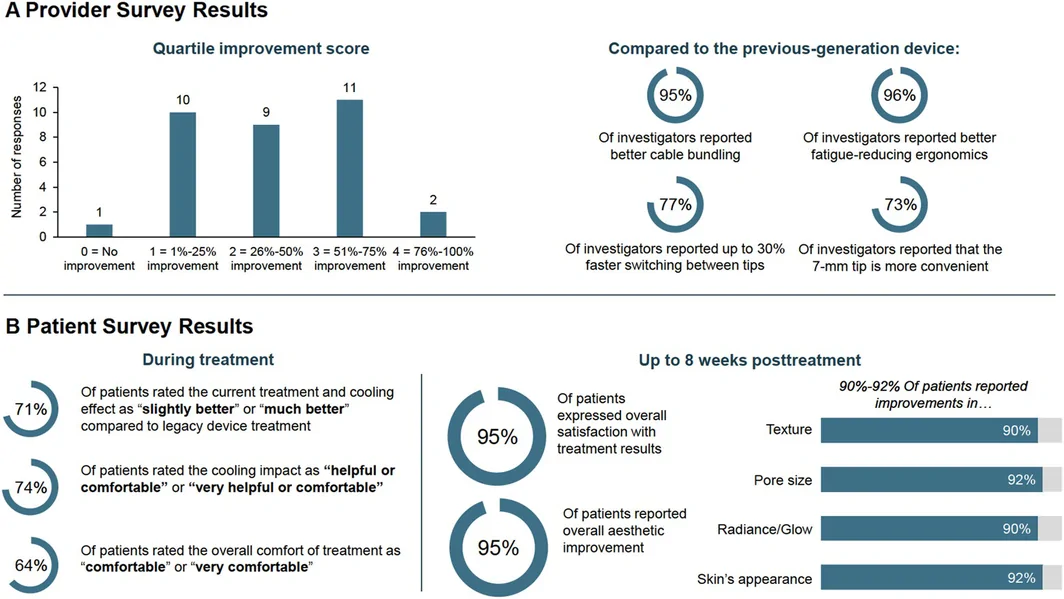
The average I‐GAIS score after treatment was 3.4 (slight‐to‐moderate improvement), and the average quartile improvement score was 2.1 (26%–50% improvement; Figure 1A ). No unexpected skin reactions or serious adverse events were reported. Most providers were “satisfied” or “very satisfied” with the system (91%) and noted it was “easy” or “very easy” to use (95%). Most providers (73%–96%) reported improvements in cable bundling, ergonomics, and tip design (Figure 1A ). Additionally, 50% of providers noted that the new tracking system reduced treatment time by up to 20%.
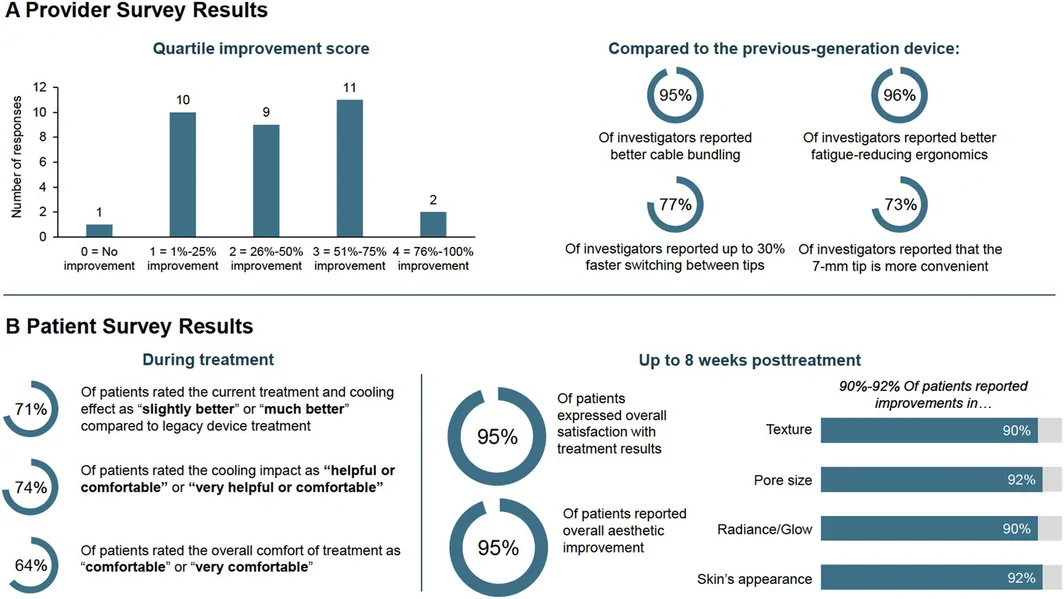
FIGURE 1 Responses to survey questions regarding (A) provider and (B) patient experiences with the next‐generation dual 1550‐nm erbium glass fiber and 1927‐nm thulium fiber non‐ablative fractional laser system.(A) 操作者、(B) 患者体验的调查应答。直观呈现满意度、易用性、舒适度分布。Most patients (74%) rated the cooling effect as helpful in improving comfort during treatment, with 64% reporting their treatment as comfortable (Figure 1B ). Patients with prior treatment with the legacy device ( n = 42) generally reported a better treatment experience with the next‐generation device (slightly better, 21%; much better, 50%). Most patients (62%) noted the healing process was “comfortable” or “very comfortable,” with no‐to‐minimal pain (88%) and discomfort (75%). Additionally, 91% were “satisfied” or “very satisfied” with the overall treatment experience. In the weeks after treatment, 95% of patients reported overall esthetic improvement and overall satisfaction with treatment results, including improvements in skin texture, pore size, radiance/glow, and skin appearance. Lastly, 87% of patients expressed interest in receiving annual treatment. Patient‐reported maximum severity ratings for redness, itching, and peeling collected 7–14 days after treatment were moderate (72%), none to minimal (63%), and moderate (51%), respectively. Representative patient photographs are shown in Figure 2 . These patients indicated the results were worth the cost and healing process.
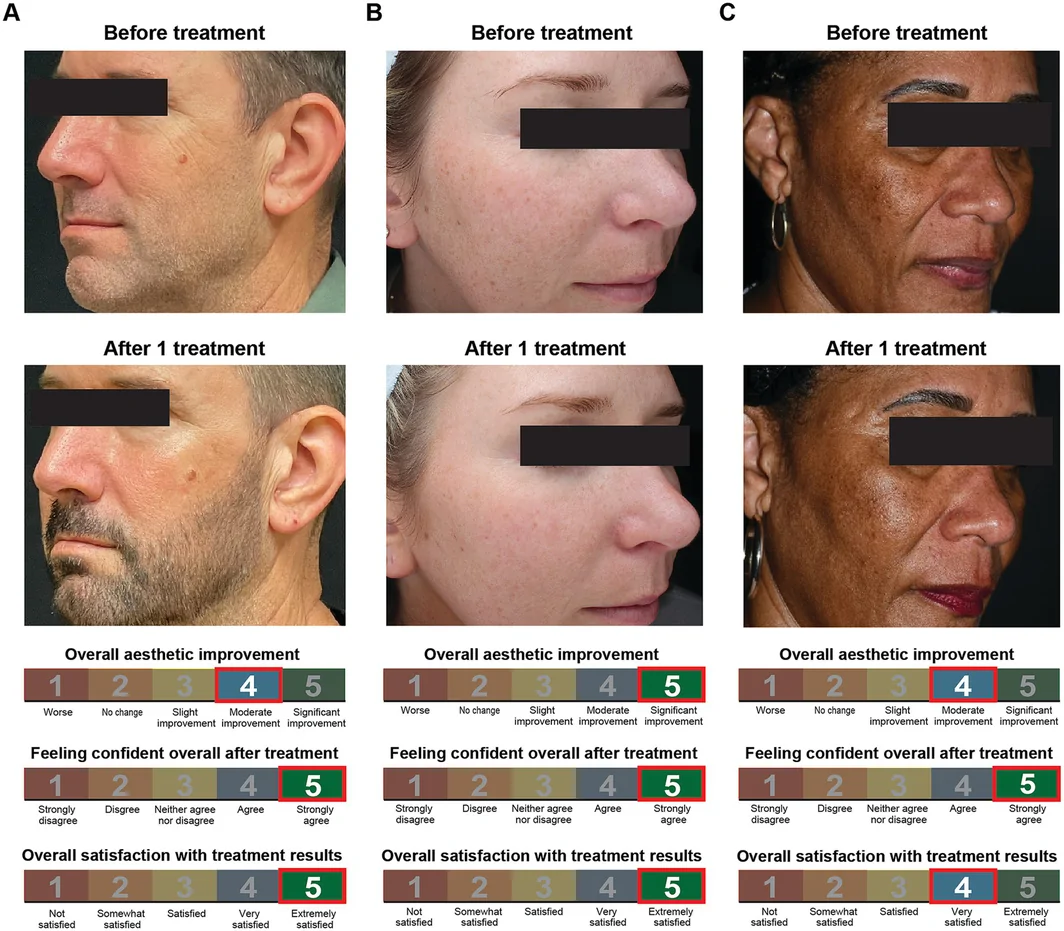
FIGURE 2 Representative patient photographs showing esthetic improvement with the next‐generation dual 1550‐nm erbium glass fiber and 1927‐nm thulium fiber non‐ablative fractional laser system, including improvement in (A) rhytids in a patient with FST II, (B) dyschromia and fine lines in a patient with FST II, and (C) melasma in a patient with FST V. “After” photos were taken 4 to 6 weeks after treatment. Patient images provided with written consent and courtesy of Dr. Suzanne L. Kilmer (panel A), Dr. Anne Chapas (panel B), and Dr. Jill Waibel (panel C). FST, Fitzpatrick skin type.代表性患者照片,展示该双波长系统的美学改善(肤质、毛孔、光泽等)。Overall, positive responses were reported for the next‐generation device, including enhanced ergonomics, features that reduced treatment time, high patient‐reported comfort and satisfaction, and esthetic improvement. Limitations included few standardized enrollment criteria that resulted in a population with minimal esthetic concerns and low potential for improvement and possible response bias related to responder attrition, although provider‐assessed outcomes did not differ by patient survey response status. This analysis suggests that the next‐generation 1550/1927‐nm non‐ablative fractional laser system represents an updated technological iteration of an existing, well‐established tool with a demonstrated safety profile.
A.C.B., J.S.D., P.M.F., A.C., J.W., M.P.G., and S.L.K. contributed to the investigation, writing – review and editing, and resources (provision of patients). S.Y.C. contributed to the formal analysis, data curation, and visualization. A.J. contributed to conceptualization, methodology, resources (study materials and instrumentation), writing – review and editing, supervision, project administration, and funding acquisition. All authors approved the final submitted version of the manuscript for publication.
This study was sponsored by Solta Medical Inc., an affiliated company of Bausch Health Companies Inc.
The authors have nothing to report.
Written consent was given for the publication of anonymized patient images.
A.C.B. has received grants or contracts, consulting fees, or honoraria from Arcutis, Avita Medical, Bausch Health, Bristol Myers Squibb, Cutera, Cytrellis, Elsevier, GLO Pharma, Hexagon Health Solutions, Lutronic/Cynosure, Masters of Aesthetics, MiMedx Group, Mooreland Associations, Northwestern Medical Faculty Foundation, Pfizer, RBC Consultants, Regeneron, Revance, Scientific Global Communications, Solta Medical, Strata Skin Sciences, and Theravant; has served as a board member or scientific board member for American Society for Dermatologic Surgery, American Society for Laser Medicine and Surgery, Bausch Health, Cutera, and Theravant; and may hold stock in Bausch Health, Cytrellis, GLO Pharma, Solta Medical, and Theravant. J.S.D. has received grants or research support from Allergan/AbbVie, Bausch & Lomb, Cutera, Cynosure, Evolus, InMode, and Revance; has been granted use of equipment from Allergan/AbbVie, Cutera, and Cynosure; has equity in Controversies & Conversations; and has served as a consultant to Allergan/AbbVie, Bausch & Lomb, Cutera, Cynosure, Fount Bio, Revance, UpToDate, and Vyome. P.M.F. has served on advisory boards for Acclaro Corp, Allergan, Candela Medical, Cytrellis, and Solta Medical; has received grants from Acclaro Corp and Bausch Health; and has received honoraria from Candela Medical and Solta Medical. A.C. has received honoraria or research funding or served on advisory boards for Allergan, Cytrellis, Evolus, InMode, Lumenis, Lutronic, Revance, Sofwave, Solta Medical, and Syneron Candela. J.W. has received research grants or consulting fees or served on scientific advisory boards for Allergan, Amgen, ArgenX, Bellanna, Bristol Myers Squibb, Candela, Cytrellis, Eli Lilly, Galderma, Janssen J&J, Lumenis, Neuronetics, Pfizer, P&G, RegenX, Sanofi, Shanghai Biopharma PWB, SkinCeuticals, and Solta Medical. M.P.G. has no disclosures relevant to this work to declare. S.L.K. has served on advisory boards for Acclaro Corp, Allergan, Cytrellis, Galderma, Lumenis, Revance, Sofwave, and Solta Medical. S.Y.C. and A.J. are employees of Bausch Health Companies Inc.
声明:中文精读 · 仅供学术参考。内容来自公开文献检索,不代表本人观点,不构成诊疗建议。 医疗美容需在正规医疗机构由执业医师实施。
基于相同主题推荐 · 继续深挖
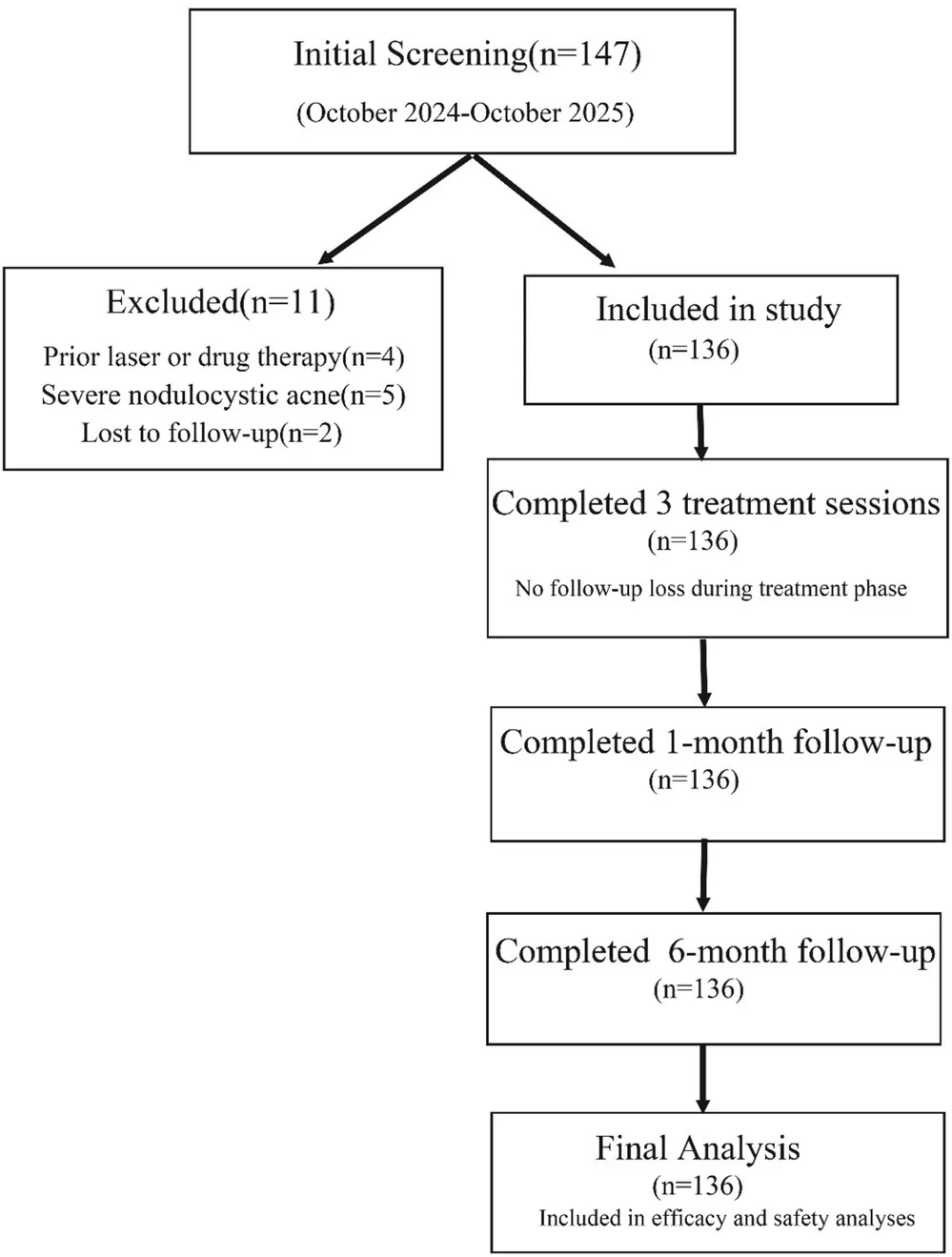
单中心回顾性真实世界研究(n=136 痤疮后红斑 PAE 患者):标准化色标引导方案为全脸低能量 532 nm KTP 扫描,再按皮损颜色定点(粉红/红用 532 nm KTP,紫
背景:评估羟基磷灰石钙(CaHA)填充注射联合 CO2 剥脱点阵激光(AFL)对萎缩性痤疮瘢痕的疗效与安全。
设备概述:新一代 Fraxel FTX(Solta Medical,2025)为 1550nm 掺铒玻璃光纤 + 1927nm 铥光纤非剥脱点阵激光,较上一代 Fraxel DUA