PLLA外轮廓点注射改善中下面部松弛:前瞻性单臂研究
2026年7月18日12 min read
Journal of Cosmetic Dermatology · 2026
Authors: Chieh Neng Wu, Peilin Hsueh, Alan Chou, Huilin Ding, Chu Chun Huang
Journal: Journal of Cosmetic Dermatology | DOI: 10.1111/jocd.71075 | PMC: PMC13373253
Conventional nonsurgical facial rejuvenation primarily relies on direct volumization to correct wrinkles and contour deficits, but may have limitations in addressing global structural changes such as tissue laxity. Emerging strategies aim to improve tissue quality and support through biostimulatory effects and may produce indirect aesthetic improvements.
To evaluate the clinical outcomes and safety of an indirect PLLA injection technique targeting outer facial contour points for improving mid- to lower-face laxity.
This prospective single-arm study included 52 participants who received three PLLA injection sessions at 1-month intervals, with 6-month follow-up after the final treatment. Injections were performed using a cannula-based fan-shaped technique in the deep subcutaneous plane. The primary outcome was change in nasolabial fold severity assessed by the WSRS. Secondary outcomes included changes in marionette lines and jawline contour, GAIS assessments, and safety. Outcomes were evaluated by an independent evaluator.
At 6 months after the final treatment, nasolabial fold severity improved, with median WSRS scores decreasing from 3.0 (IQR: 3.0–3.0) to 2.0 (IQR: 1.0–2.0). A total of 92.3% of participants achieved at least a 1-grade improvement. Consistent improvements were also observed in marionette lines and jawline contour. Overall, more than 95% of participants were rated as improved or better on GAIS by both evaluator and participants. No serious adverse events were reported, and all treatment-related adverse events were mild and transient.
PLLA injection at selected outer facial contour points was associated with improvements in mid- to lower-face aesthetic scales and a favorable safety profile. This approach may represent a promising exploratory strategy for aesthetic improvement in addition to, or partly distinct from, conventional volumization-based effects.
Keywords: biostimulation; indirect injection; nasolabial folds; poly-L-lactic acid; structural rejuvenation
Facial aging is characterized by volume loss, skin laxity, and deepening wrinkles, particularly in the mid- to lower face [1]. Conventional nonsurgical rejuvenation strategies, including dermal filler injections, primarily aim to correct these changes through direct volumization, focusing on the localized filling of wrinkles and contour deficits [2]. While effective in restoring volume and improving wrinkle appearance, such approaches may have limitations in addressing global structural changes, including tissue laxity and reduced skin elasticity [3].
Increasing evidence suggests that facial aging is not solely the result of isolated wrinkle formation, but rather reflects complex structural and biomechanical alterations involving the extracellular matrix (ECM) and soft tissue support [4]. Accordingly, there is growing interest in strategies that restore structural integrity and tissue tension, rather than relying exclusively on localized volumization.
Poly-L-lactic acid (PLLA) is a well-established biostimulatory agent that induces collagen production and promotes gradual tissue remodeling [5]. Traditionally, PLLA has been applied through direct injection into wrinkles or volume-deficient areas [6]. Strategic injection at outer facial contour points has been proposed as a technique that may improve adjacent facial appearance through biostimulatory remodeling; however, the underlying biomechanical mechanism remains unproven [7,8]. Compared with conventional volumization-based approaches, this indirect strategy focuses on enhancing global structural support and may be associated with changes in overall facial contour appearance, rather than effects limited to localized volume augmentation.
Although this concept is biologically plausible, clinical evidence supporting the effectiveness of indirect structural lifting using PLLA remains limited. Therefore, the present study aimed to evaluate the efficacy and safety of this indirect injection approach in improving mid- to lower-face laxity.
This study was designed as a prospective single-arm study to evaluate the efficacy and safety of PLLA injections for improving laxity and wrinkles in the mid- to lower face. All 52 participants received the same PLLA injection treatment, with follow-up conducted over a 6-month period.
The study was conducted between May 2023 and March 2025. The study protocol was approved by an independent institutional review board and was conducted in accordance with the principles of the Declaration of Helsinki. Written informed consent was obtained from all participants prior to enrollment.
Participants were recruited through outpatient clinics and included healthy adults aged 30 to 55 years with Fitzpatrick skin types III or IV [9]. Eligible participants were required to have nasolabial folds with a Wrinkle Severity Rating Scale (WSRS) score [10] of 2 to 4.
The PLLA facial filler (Löviselle; Changchun SinoBiomaterials Co. Ltd.), synthesized using LaSynPro technology, was supplied as a lyophilized product containing 340 mg per vial, including 150 mg of PLLA microspheres, 45 mg of carboxymethylcellulose, and 145 mg of mannitol. Each vial was consistently reconstituted with 2 mL of sterile saline and 1 mL of 2% lidocaine, yielding a final volume of 3 mL per vial and an approximate PLLA microsphere concentration of 50 mg/mL [12].
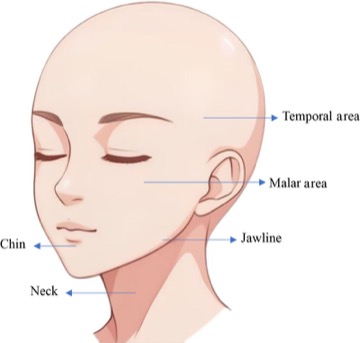
Each patient underwent three treatment sessions at 1-month intervals using the same reconstitution protocol. Using a 25-G cannula (50-mm length), retrograde injections were performed in a fan-shaped pattern in the deep subcutaneous plane. Each entry point (C1: temporal region, C2: supramalar region, C3: pretragal region) involved 3–5 linear retrograde passes ("threads") to evenly distribute approximately 1.0–1.5 mL of product within the intended treatment zone. This resulted in a total injection volume of approximately 4.5 mL per side and 9 mL per treatment session.
Figure 1 Schematic illustration of injectable PLLA injection technique. C1, temporal region; C2, supramalar region; C3, pretragal region. (图片文件: JOCD-25-e71075-g002.jpg)
Immediate post-injection massage was performed for 2–3 min in the clinic to ensure even product distribution, whereas no further home massage was required in the subsequent days, which differs from conventional PLLA protocols that typically recommend repeated post-treatment massage.
Participants were followed up for 6 months after the final treatment. Clinical outcomes were assessed using region-specific validated scales, including the Wrinkle Severity Rating Scale (WSRS) for nasolabial folds, the Marionette Lines Grading Scale for marionette lines, and the Facial Laxity Rating Scale (FLRS) for jawline contour [13,14]. All evaluations were performed by a single independent evaluator.
Statistical analyses were primarily descriptive, given the exploratory nature of this single-arm study. Ordinal clinical scale variables were summarized primarily using median values and interquartile ranges (IQR). Changes from baseline to 6 months after the final treatment were analyzed using the Wilcoxon signed-rank test. A two-sided p-value < 0.05 was considered statistically significant.
Among the 52 patients, the mean age was 41.62 ± 5.46 years (range, 31–54 years). The majority were female (98.1%). Most patients had Fitzpatrick skin type III (69.2%), followed by type IV (30.8%).
Table 1 Demographic and clinical characteristics of the patients (n = 52).
| Characteristic | Patients (n = 52) |
|---|---|
| Sex, no. (%) | |
| Men | 1 (1.9) |
| Women | 51 (98.1) |
| Age, mean ± SD, (range) | 41.62 ± 5.46 (31–54) |
| Fitzpatrick skin type, n (%) | |
| Type III | 36 (69.2) |
| Type IV | 16 (30.8) |
WSRS scores for nasolabial folds showed a consistent reduction across all participants. In 52 participants, the median WSRS score decreased from 3.0 (IQR: 3.0–3.0) at baseline to 2.0 (IQR: 1.0–2.0) at 6 months, corresponding to a median improvement of 1 grade. A total of 92.3% (48/52) of participants achieved at least a 1-grade improvement, with no cases of worsening and 7.7% showing no change. The reduction in WSRS scores was statistically significant (p < 0.001).
Figure 2 Changes in nasolabial fold WSRS scores from baseline to 6-month follow-up. (a) Individual paired plot. (b) Box-and-whisker plots. (图片文件: JOCD-25-e71075-g004.jpg)
Significant improvement in marionette lines was observed at 6 months. The median Marionette Lines Grading Scale score decreased from 2.0 (IQR: 1.0–3.0) at baseline to 1.0 (IQR: 0.0–1.0) at 6 months (p < 0.001).
The median FLRS score for jawline contour decreased from 5.0 (IQR: 3.0–6.0) at baseline to 3.0 (IQR: 2.0–3.25) at 6 months, indicating a median reduction of 2 grades (p < 0.001).
Figure 3 Changes in marionette line and jawline contour scores from baseline to 6-month follow-up. (a) Marionette Lines Grading Scale. (b) Facial Laxity Rating Scale for jawline contour. (图片文件: JOCD-25-e71075-g003.jpg)
Table 2 Changes in facial aesthetic scores across treatment regions (n = 52).
| Outcome | Baseline median (IQR) | 6 months median (IQR) | Median change (IQR) | Responder rate ≥1 grade | Wilcoxon W | p |
|---|---|---|---|---|---|---|
| Nasolabial folds (WSRS) | 3.0 (3.0–3.0) | 2.0 (1.0–2.0) | 1.0 (1.0–2.0) | 92.3% (48/52) | 0 | 5.10×10⁻¹⁰ |
| Marionette lines | 2.0 (1.0–3.0) | 1.0 (0.0–1.0) | 1.0 (1.0–2.0) | 90.4% (47/52) | 0 | 9.23×10⁻¹⁰ |
| Jawline contour (FLRS) | 5.0 (3.0–6.0) | 3.0 (2.0–3.25) | 2.0 (1.0–3.0) | 90.4% (47/52) | 0 | 1.38×10⁻⁹ |
Investigator-assessed GAIS results showed that the majority of participants were rated as improved or better (GAIS ≤ 3), with 13.5% classified as very much improved and 30.8% as much improved. Only 1.9% of participants showed no change, and no cases of worsening were observed. Participant-reported GAIS outcomes demonstrated a similar distribution, with 96.2% of participants reporting improvement or better.
Figure 4 GAIS score at 6 months after the final treatment. (a) Investigator-assessed GAIS scores. (b) Participant-reported GAIS scores. (图片文件: JOCD-25-e71075-g001.jpg)
Representative clinical photographs further illustrate visible clinical changes across different facial regions. Improvement in nasolabidal folds was characterized by a visible reduction in fold depth and softening of the crease. Marionette lines demonstrated visible attenuation, with decreased line prominence and improved perioral contour. Jawline contour exhibited enhanced definition, with reduced lower facial laxity and improved mandibular border clarity.
Figure 5 Representative standardized clinical photographs obtained before treatment, immediately before the final treatment, and at 6-month follow-up. (图片文件: JOCD-25-e71075-g005.jpg)
Adverse events following PLLA injection were prospectively monitored. Mild swelling was reported in 2 participants (3.8%) immediately after the first treatment session and resolved within 1 month. Postoperative pain was noted in 1 participant (1.9%) immediately after the second treatment session. No other adverse reactions, including erythema, bruising, nodules, granulomas, or vascular events, were observed. No serious adverse events were reported.
Table 3 Incidence of adverse events at immediate post-treatment and follow-up time points.
| Adverse Event | After session 1 | 1 mo after S1 | After session 2 | 1 mo after S2 | After session 3 | 6 mo after final |
|---|---|---|---|---|---|---|
| Mild swelling | 2 (3.8%) | 0 | 0 | 0 | 0 | 0 |
| Erythema | 0 | 0 | 0 | 0 | 0 | 0 |
| Postoperative pain | 0 | 0 | 1 (1.9%) | 0 | 0 | 0 |
| Bruising | 0 | 0 | 0 | 0 | 0 | 0 |
| Nodules | 0 | 0 | 0 | 0 | 0 | 0 |
| Granulomas | 0 | 0 | 0 | 0 | 0 | 0 |
| Vascular events | 0 | 0 | 0 | 0 | 0 | 0 |
This study explored the use of PLLA injections as an indirect method for improving mid- to lower-face laxity. The results demonstrated consistent improvements across multiple validated clinical scales, with 92.3% of participants achieving at least a 1-grade improvement in WSRS scores.
Vectra imaging provided illustrative visual documentation of changes in facial contour over time, including both treated and adjacent regions, without quantitative assessment of tissue displacement. The color overlay is illustrative only and should not be interpreted as a validated quantitative displacement measurement.
Previous reports on vector lifting have primarily involved hyaluronic acid [21]. However, PLLA offers a biostimulatory effect focused on regeneration rather than volumization. Other stimulators, such as calcium hydroxylapatite and polycaprolactone, have been reported but remain less studied [22,23].
Despite overall positive outcomes, interindividual variability was observed, likely influenced by baseline skin type, age, and laxity severity [25], as well as technical factors such as cannula depth, fan distribution, and operator experience. This underscores the importance of patient selection and tailored injection strategies.
The treatment was well tolerated, with only mild and transient adverse events and no long-term complications observed up to 6 months after the final treatment. The relatively small sample size and the predominance of female participants, as well as the limited range of Fitzpatrick skin types, may limit broader applicability. The lack of a control or comparator group limits causal interpretation.
The use of PLLA injections at outer contour points was associated with consistent improvement in mid- to lower-face laxity, with a favorable safety profile. While further studies with extended follow-up and broader populations are warranted, these findings suggest the potential of an indirect, biostimulatory approach to facial rejuvenation that may contribute to aesthetic improvement in addition to, or partly distinct from, conventional volumization-based effects.
⚠️ 本文为医学文献全文精读,内容仅供学术参考,不构成医疗建议。
⚠️ 本文图片因PMC下载限制暂无法自动获取,已保留原图注和文件名,可通过PMC页面手动查看。
声明:中文精读 · 仅供学术参考。内容来自公开文献检索,不代表本人观点,不构成诊疗建议。 医疗美容需在正规医疗机构由执业医师实施。
基于相同主题推荐 · 继续深挖
2026/07/18 · 文献笔记 · 12 min read
52名受试者接受3次PLLA外轮廓点注射(C1颞部、C2颧上、C3耳前),每次间隔1个月。6个月随访显示:WSRS从3.0降至2.0(92.3%改善≥1级),木偶纹和下颌轮廓均有显著改善,95%以上GAIS评为改善或更好,无严重不良事件。
本综述系统总结了PLLA面部与颈部年轻化注射的最新进展,涵盖新型递送系统(激光无针微射流注射)、改进注射技术(L-Lift技术、超声引导)、材料创新(粒径优化、PLLA-PEG/HA复合配方)及临床循证数据。PLLA效果维持18-24个月以上,患者满意度超90%,是效果持续时间最长的非手术面部年轻化选项之一。
2026/07/20 · 文献笔记 · 54 min read
一篇系统性循证综述:比较HA、CaHA、PLLA、PMMA等填充剂的材料特性与流变学参数;详述面部血管解剖与高危区(眉间、鼻、泪沟、鼻唇沟、内眦);总结注射技术(线性逆行、连续点、扇形、交叉、bolus)、器械选择(锐针vs钝针)与并发症管理(尤其血管性栓塞的早期识别与高剂量透明质酸酶急救)。附7张临床/解剖原图。